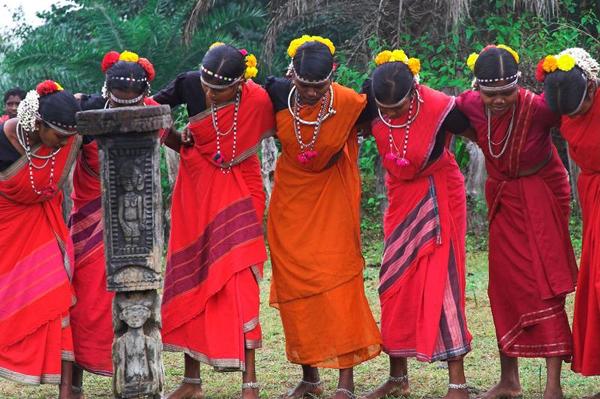
Chhattisgarh is a home to a number of types of tribal communities. It has the largest population of tribals in the state. It is assumed that the earliest tribals have been living in Bastar for over 10,000 years. Each of these communities, has its own rich and distinctive history and culture of music, dance, dress and food. Chhattisgarh is popularly famous for its festivals and it can be evidently seen through the means of their varied cultures. An explosion of music and colour, a generous dose of spirituality, a liberal helping of sheer exuberance all topped with age-old tribal traditions. The Saila Dance is one of those many dances in this state, which is famous for its uniqueness.
Saila Dance, the famous folk dance of Chhattisgarh
In the month of Aghan, the villagers go to the adjoining villages to perform the Saila Dance. The group of Saila Dancers go to each house and perform this dance. The young boys from the plains of Chhattisgarh participate in this dance form perform, in order to have great enthusiasm & spirit after the post-harvest time. Saila in its simplest form is also performed as the Dasera dance that is always performed by the Baigas before festival of Diwali.
Folk Dance of Chhattisgarh: The Saila dance is a stick-dance that is popular in many regions of the state, among the people of Sarguja, Chhindwara and Baitul districts. But in these places, Saila is known by the Danda Nach or Dandar Pate. Saila dance can be performed in number of ways. Some of them are named as the Baithiki Saila, the Artari Saila, the Thadi Saila, the Chamka Kunda Saila, the Chakramar Saila (lizard's dance) and the Shikari Saila. Each form of variation is based on a certain theme and distinctive feature as its own identity.
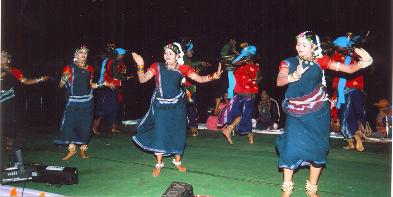
The dancers in this folk dance of Chhattisgarh have small sticks in their hand and this stick is struck, next to the stick of the person who is dancing near to him. They move in circles in clockwise direction, then they turn around and move anti-clockwise. The "Mandar" gives the beat to the dancers. When the beat becomes fast, the dancers also move faster. The sticks are once hit against each other, when the arms are stretched upwards and then when the arms come down.
Hence, the Saila dance is performed with many variations in dancing style & pattern. Sometimes the dancers stand together, forming a circle. Here, each one stands on one leg and takes support by holding on to the man in front. Then they all dance together, or sometimes, they pair off or go around in a single or double line, climbing each other's back. The climax in the performance of Saila is the great Snake dance.
